






















No Deposit Bonus
Free credit after sign-up. Risk-free, but profit is usually capped.
Deposit Bonus
Extra margin on top of your deposit. Unlocks after a set number of lots.
Trading Contests
Compete on demo or live accounts for real cash prizes.

Discover forex no deposit and deposit bonus offers from leading brokers. Compare promotions, review terms, and find opportunities to start trading.

Connecting…
Loading chart…
| Coin | Price (USDT) | 24h % | |||
|---|---|---|---|---|---|
| Connecting… | |||||


 How the BYNIX Capital $50 Black Friday Welcome Bonus Works
 Valetax $35 Welcome Bonus How It Works and What to Know
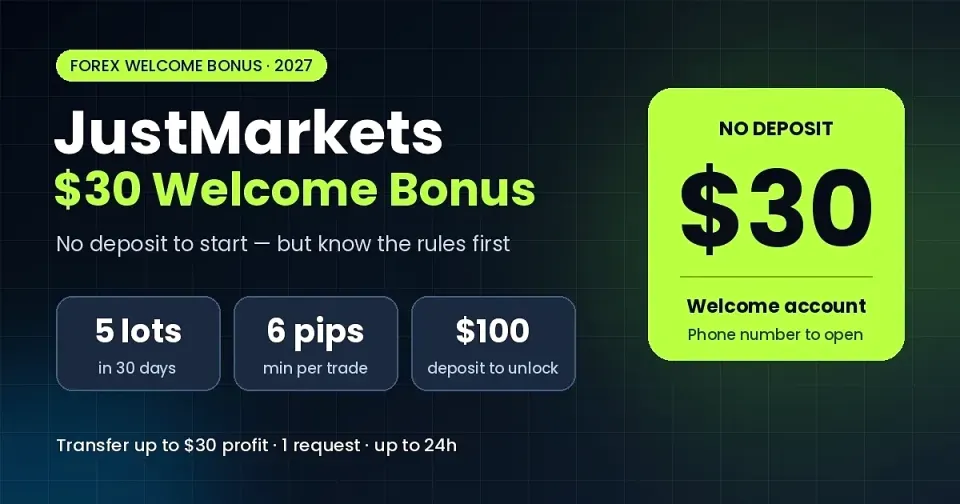
 JustMarkets $30 Welcome Bonus 2027 Terms, Trading Rules
 YWO $100 No-Deposit Bonus Terms, Eligibility, and Claim Steps
 BestMarkets $250 Forex Trading Gift Card Offer Details and What to Check
 InstaForex 100% Forex Welcome Bonus for New Clients
 RoboForex $30 Welcome Bonus and 120% Deposit Bonus
 Olymptrade Birthday Event 2027 112% Deposit Bonus Review
 XQuotes $25 Free No Deposit Bonus Release Rules, and Risks
 How to Enter Headway $1 Forex Trading Challenge
 YWO Broker $100 Free Forex No Deposit Bonus FAQs Answered
 WOW Trade Wins Best Trading Platform 2027 Award Review

A forex bonus is extra trading credit from a broker. You can keep the profit once you trade the required volume, so always check that rule first.
Free credit after sign-up. Risk-free, but profit is usually capped.
Extra margin on top of your deposit. Unlocks after a set number of lots.
Compete on demo or live accounts for real cash prizes.
Straight answers about how forex bonuses work, what it takes to withdraw, and how trading contests and brokers really operate.
After you register and pass identity checks, the broker adds a fixed amount of trading credit — often $10 to $150 — to a live account. You open real trades with that credit. The credit itself stays locked, but any profit you make becomes withdrawable once you meet the broker's volume rule, usually within a set number of days.
It is a customer-acquisition cost. Brokers earn from spreads, commissions and overnight swaps on every trade, so a client who keeps trading for months easily repays a $50 bonus. The volume requirement attached to the bonus is how the broker makes sure that cost is recovered before any money leaves the account.
Almost always, yes. Regulated and offshore brokers alike ask for a photo ID and a recent proof of address (KYC) before activating a bonus or approving a withdrawal. Verifying before you trade avoids the common problem of earning profit and then waiting days for documents to be approved.
Yes — a no deposit bonus is one of the safest ways to learn on a live account because none of your own money is at risk. Start with the smallest lot size, use a stop-loss on every trade and treat the credit as tuition. Practising first on a free demo account makes the bonus last much longer.
Divide the bonus amount by the broker's per-lot value. For example, a $60 bonus with a rule of “1 standard lot per $3 of bonus” needs 20 standard lots (or 200 mini lots of 0.10). Compare that number with how much you normally trade per week to see whether the target is realistic before the bonus expires.
Usually. Most no deposit offers limit withdrawable profit to a fixed figure, commonly between $50 and $500, regardless of how much the account makes. Deposit bonuses rarely have a profit cap, but they convert to cash only after the lot requirement is completed. The cap is always stated in the bonus terms.
On many deposit-bonus accounts, the bonus is removed once your own equity drops to zero, and your open trades can be closed at the stop-out level earlier than you expect. With a no deposit bonus, losing the credit simply ends the promotion — you never owe the broker money. Keep position sizes small to avoid both outcomes.
Not with the same broker in most cases — offers are normally limited to one per person, household, IP address or device, and stacking two promotions can void both. You can hold bonuses with different brokers, but track each set of terms separately so you don't miss a volume target or expiry date.
Most contests rank participants by percentage gain on their account balance or equity at the end of the round, so a $1,000 account that grows to $1,800 beats one that grows to $1,500. Some live contests rank by trading volume or use raffle tickets instead. Check whether open trades count and what the minimum number of trades is.
No. Demo contests run on virtual funds, so any losses are imaginary and entry is free. The prizes, however, are real — usually cash, funded accounts or gadgets — and are paid after the winner verifies their identity. Some brokers ask winners to open a live account to receive the prize.
Look up the broker's licence number on the regulator's own website, read the full bonus terms before registering, and search recent user reviews for withdrawal complaints. Be wary of offers above 200%, terms that let the broker cancel profits “at its discretion”, and anyone pressuring you to deposit quickly through social media.
A no deposit bonus is better for testing a broker's platform, spreads and withdrawal speed with zero risk. A deposit bonus suits traders who already have a tested strategy and want extra margin. Many traders use a no deposit bonus first, then fund the account only if the broker passes that test.
Risk warning: Forex and CFD trading involves high risk and may not be suitable for every investor. Bonus offers are set by each broker and can change or end without notice — always read the official terms before you trade.